
Common Quran Recitation Mistakes That Turn Your Blessings Into Major Sins
For every practicing Muslim, reciting the Holy Quran is one of the ultimate acts of worship. It serves as a source of immense spiritual peace and forms a direct link to our Creator. Furthermore, the Prophet Muhammad (peace be upon him) taught us that whoever recites a single letter from the Book of Allah receives a reward, and that reward is multiplied tenfold.
However, many Muslims worldwide remain completely unaware of a critical risk. Specifically, certain common Quran recitation mistakes can completely ruin this reward. Mispronouncing a single letter is not a small matter. Similarly, swapping a vowel movement (Harakat like Zabar, Zer, or Pesh) can completely reverse or corrupt the divine meaning of a verse.
Consequently, instead of accumulating mountain-sized rewards from Almighty Allah, reciting with lazy, indifferent, and uncorrected errors can actually cross into the territory of a major sin (Haraam). This comprehensive analysis dissects these mistakes. Ultimately, it exposes why they alter the message of the Quran, how they affect your daily prayers, and how you can protect your family.
Understanding Lahn Jali and Lahn Khafi in Recitation
In the rigorous science of Tajweed, Islamic scholars divide errors into two primary categories based on their grammatical severity. These deviations are known under the umbrella of Lahn (linguistic mistakes in speech).
1. Lahn Jali (The Clear & Major Mistakes) — Strictly Haraam
Lahn Jali refers to clear, obvious, and major errors that violate the fundamental rules of the Arabic language. Therefore, these are the most dangerous types of common Quran recitation mistakes. They alter the structural integrity of words and corrupt core theological meanings.
- Swapping Vowels (Harakat): This happens when a reciter carelessly changes a Zabar (Fathah) to a Zer (Kasrah), or a Zer to a Pesh (Dammah).
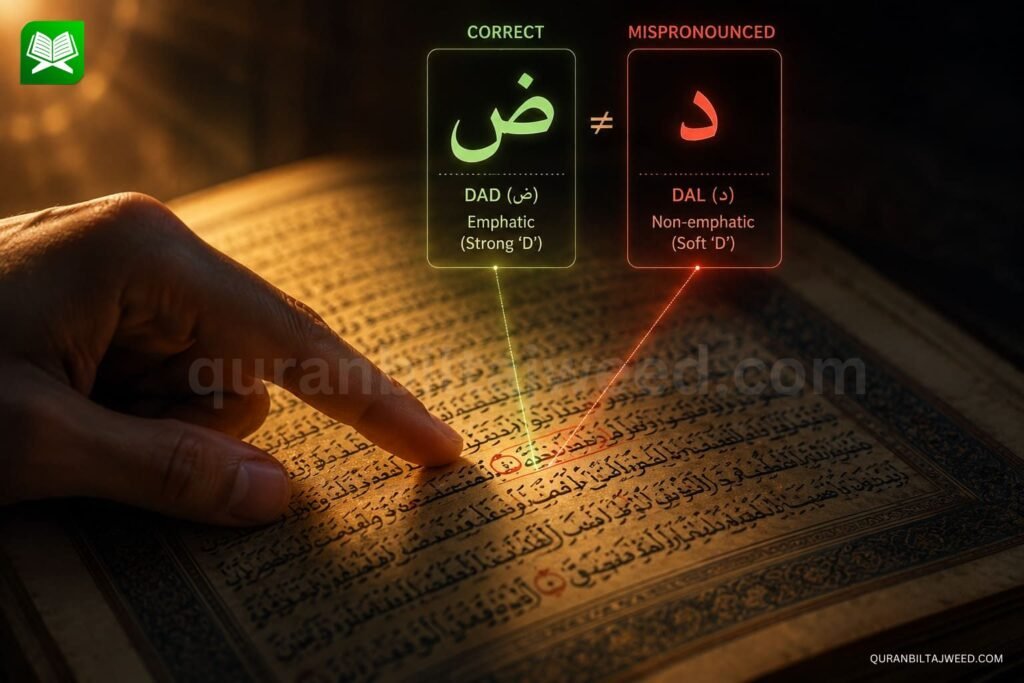
- Swapping Letters (Huroof): This occurs due to incorrect tongue, lip, or throat placement (Makharij). As a result, the reciter fails to differentiate between similar-sounding Arabic letters. For example, they might substitute a soft, light letter for a heavy, thick letter.
- Adding or Deleting Letters: This error involves accidentally stretching a short vowel marker into a long vowel. Consequently, it adds an invisible letter to the divine text. Alternatively, short-changing a long vowel makes an essential letter disappear entirely.
The Islamic Ruling: If a person has the resources to learn correct pronunciation but deliberately neglects studying Tajweed, practicing Lahn Jali is strictly forbidden (Haraam). It becomes a major sin because the reader continues to recite carelessly and actively alters Allah’s direct, unchangeable speech.
2. Lahn Khafi (The Hidden & Minor Mistakes) — Disliked (Makruh)
In contrast, Lahn Khafi refers to technical, hidden mistakes regarding the aesthetic perfection, beauty, and traditional melody of recitation rules. Crucially, these do not disrupt the foundational Arabic language structure, nor do they change the dictionary definitions of the words.
- Examples of Minor Flaws: These mistakes include shortening the exact duration of a Ghunnah (the nasal sound made through the nose). In addition, failing to apply proper Ikhfa (hiding a sound), under-stretching a Madd (long elongation), or omitting Qalqalah (the echoing sound) fall into this category.
- The Islamic Ruling: These mistakes must be avoided to show complete respect to the traditional way the Quran was revealed. However, they do not corrupt the actual meaning of the words. Therefore, scholars generally classify Lahn Khafi as disliked or improper (Makruh) rather than strictly sinful.
How Common Quran Recitation Mistakes Change the Meaning
To understand why scholars view Lahn Jali with such severity, we must dissect real linguistic examples. A tiny, microscopic shift in your mouth can create an entirely different phrase in Arabic. Because of this structural sensitivity, these slips are classified as critical common Quran recitation mistakes.
Case Study 1: The Catastrophic Switch of Zabar and Pesh
The single most common area where untrained readers fall into major sin is ignoring the strict placement of vowel markings (Harakat). For instance, let us examine the absolute core of our daily prayers: Surah Al-Fatiha (Verse 7).
صِرَاطَ الَّذِينَ أَنْعَمْتَ عَلَيْهِمْ
- The Correct Recitation:An’amta ‘alayhim
- The True Divine Meaning: “The path of those upon whom You (Almighty Allah) have bestowed favor.”
- The Fatal Mistake: Reading the Zabar on the letter “Ta” (تَ) as a Pesh (تُ). This transforms the phrase into An’amtu ‘alayhim.
- The Corrupted Meaning: “The path of those upon whom I have bestowed favor.”
The Theological Nightmare: By carelessly shifting a single tiny vowel dash, the reader shifts the entire action of bestowing divine favor from Almighty Allah onto themselves. If a person makes this mistake intentionally, or through complete laziness and a refusal to learn, it completely invalidates the Salah (prayer) and constitutes a severe sin.
Case Study 2: Mixing Heavy and Light Letters (Makharij Failures)
The Arabic language is incredibly precise. Specifically, it contains letters that may sound nearly identical to a non-Arab ear, but they originate from entirely different physical articulation points (Makharij) inside the mouth.
- The Intended Word: قَلْب (Qalb — spelled with a deep, heavy, thick Qaf)
- The Meaning: Heart.
- The Careless Mistake: Pronouncing the heavy Qaf (ق) lightly as a standard English Kaf (ك). This causes the word to be read as Kalb (كَلْب).
- The Corrupted Meaning: Dog.
The Contextual Disaster: Consider a beautiful verse where Allah speaks about purifying the “hearts” of the true believers. If a reciter flattens their tongue and says Kalb instead of Qalb, the meaning changes completely. Consequently, they are loudly proclaiming that Allah purifies the “dogs” of the believers.
Case Study 3: The Destruction of Allah’s Attributes (Ayn vs. Hamzah)
Furthermore, failing to squeeze the middle of the throat to correctly pronounce the letter Ayn (ع) routinely turns praises of God into inadvertent insults.
- The Intended Attribute: عَلِيم (‘Aleem — starting with a deep, clear Ayn)
- The Meaning: The All-Knowing (An exclusive, beautiful name of Almighty Allah).
- The Careless Mistake: Relaxing the throat completely and pronouncing it from the mouth or upper chest as Aleem (أَلِيم — starting with a flat Hamzah/Alif).
- The Corrupted Meaning: Painful / Agonizing / Grievous.
The Contextual Disaster: When trying to declare that “Allah is All-Knowing,” this lazy pronunciation shifts the phrase to mean “Allah is Painful.” Therefore, a beautiful attribute of mercy is replaced with a word denoting agony.
Universal Cheat Sheet: Avoiding Common Quran Recitation Mistakes
| Correct Word | True Meaning | Careless Mistake | Corrupted Meaning | Linguistic Nature of Error |
| An’amta | You (Allah) favored | An’amtu | I favored | Harakat (Vowel) Swap |
| Qalb | Heart | Kalb | Dog | Makhraj (Letter) Flattening |
| ‘Aleem | All-Knowing | Aleem | Painful | Makhraj (Throat) Failure |
| As-Samad | The Eternal / Absolute | As-Samat | The Silent One | Letter Substitution (Dal to Ta) |
| Khalaqa | He Created | Halaqa | He Shaved / Damaged | Letter Substitution (Kha to Haa) |
Divine Mercy: Learning to Fix Your Errors
Reading about these fatal mistakes can feel terrifying. However, it is vital to understand the vast boundary line between a struggling student and a negligent rejector. Islam is built upon intentions and effort. Therefore, Almighty Allah does not demand instant perfection from someone who is actively trying to master their tongue and eliminate these common Quran recitation mistakes.
Our beloved Prophet Muhammad (peace be upon him) provided ultimate clarity and comfort for those who are trying:
“The one who recites the Quran beautifully, smoothly, and precisely, he will be in the company of the noble and obedient angels. And as for the one who recites with difficulty, stammering or stumbling over its words, he will have a double reward.” (Sahih Al-Bukhari)
The Status of the Sincere Student
If you, your spouse, or your children are enrolled in a structured class, you are fully protected. While practicing regularly and listening to a qualified tutor, your intentions remain clean. Therefore, when your tongue slips accidentally during a practice session, you are not sinning. On the contrary, Allah rewards you twice: once for the text you spoke, and once for the sweat, tears, and exhaustion of trying to fix your tongue.
The Status of the Negligent Sinner
In contrast, the sin strictly targets the individual who knows deep down that their reading contains errors, yet simply does not care. For example, they realize they cannot properly differentiate Zabar, Zer, or Pesh, or they notice they are flattening their throat letters. Despite this awareness, they refuse to sign up for classes, refuse to let a teacher correct them, and continue to casually read the Quran with major, meaning-altering errors out of pure pride or laziness.

Conclusion: How to Prevent Common Quran Recitation Mistakes
Reciting the Holy Quran without Tajweed is like building a house without a solid foundation. Consequently, a single shift can cause the entire structure to collapse. As Muslims, we must protect our Salah. Furthermore, we must ensure that our children are learning the true, unmodified words of Almighty Allah.
Take the time to audit your recitation under a certified expert today. Embrace the struggle of learning, and systematically eliminate these common Quran recitation mistakes from your daily worship.
Protect Your Family From Fatal Recitation Errors Today
As explained in this article, even a tiny mistake like swapping a Zabar for a Pesh or flattening a heavy letter can completely turn your blessings into a major sin. Don’t leave your or your children’s daily prayers to chance.
Get a Free 3-Day Recitation Audit & Trial Class under our expert, certified Tajweed teachers. We will personally check your pronunciation and clear any hidden errors.