
7 Common Tajweed Mistakes Kids Make in Surah Al-Fatiha (And How to Fix Them)
There is a unique joy in standing next to your child in Salah and hearing them recite the Quran. However, if you listen closely, you might catch a few slips in their pronunciation. Because children often memorize Surah Al-Fatiha by just listening at a young age, they tend to pick up small phonetic errors that become habits. Identifying these Tajweed mistakes in Surah Fatiha early on is vital for every parent.
Correcting pronunciation slips early is crucial. When children memorize without a strong phonetic foundation, they use English equivalents to produce Arabic sounds, which can alter the actual meaning of the verses. In this guide, we will explore the exact mistakes your child might be making, why they happen, and how you can help fix them.
The Importance of Surah Al-Fatiha in Daily Worship
Surah Al-Fatiha is the absolute core of our daily worship. A Muslim recites this Surah at least 17 times a day during the obligatory prayers. Because it is a fundamental pillar of Salah, perfecting its Tajweed is crucial for every Muslim child.
Arabic is an incredibly precise language. A slight shift of the tongue can change a beautiful prayer into a completely different statement. Ensuring that the 17 times they speak to Allah every single day are done with accuracy and respect is one of the greatest gifts a parent can give.
7 Common Tajweed Mistakes in Surah Fatiha (And How to Fix Them)
Surah Al-Fatiha contains several challenging Arabic letters that require specific articulation points, or Makharij. Here are the most frequent Tajweed mistakes in Surah Fatiha that kids make and how to address them.
Mistake 1: Confusing ‘Ayn (ع) with Alif (أ) in “An’amta”
In the verse “Siraat al-latheena an’amta ‘alayhim,” the word “an’amta” features an Alif (أ) right next to an ‘Ayn (ع). Because the English language does not have the ‘Ayn sound, kids often say “An-amta”, completely dropping the middle-throat squeeze.
The Fix: The ‘Ayn comes from the middle of the throat. Have your child gently place their fingers on their neck and practice squeezing those muscles to make a sound like they are fogging up glasses, but with their voice turned on.
Mistake 2: Heavy vs. Light Letters – Mispronouncing Taa (ط) as Taa (ت)
When kids reach the word “As-Siraat”, they often replace the heavy Taa (ط) with the light, smiling Taa (ت) that sounds like an English ‘T’. Instead of a deep “SiraaT”, they say a sharp “Siraat”.
The Fix: Tell your child to keep their lips straight, point the tip of their tongue to the roof of their mouth, and raise the back of their tongue. Visualizing their mouth filling with air helps them grasp the concept of heavy letters.
Mistake 3: Rolling or Softening the Raa (ر) Sounds
In “Ar-Rahman Ar-Raheem,” kids either curl their tongue back to sound like an English ‘R’ or roll it excessively like a motor. The Arabic Raa must be heavy here but should only tap the roof of the mouth once or twice.
The Fix: Teach them to strike their gums just behind their top teeth for a split second and drop the tongue immediately. This precise control is exactly why taking the time to learn Noorani Qaida online is so beneficial for young learners.
Mistake 4: Changing the Haa (ح) into a Standard H (هـ)
In “Alhamdulillahi”, the crisp, sharp Haa (ح) is often replaced with the soft, chest-based Haa (هـ). They will say “Al-hamdu” with the same breathy sound used for the English word “Hello”.
The Fix: The sharp Haa is a friction sound. Ask them to imagine they just ate something spicy and are pushing air out of their throat to cool it down.
Mistake 5: Swapping Seen (س) and Saad (ص)
The word “Siraat” starts with a heavy Saad (ص), but children often read it as a light Seen (س). Mixing up heavy and light letters in the same sentence is very common.
The Fix: Use the “smile test”. When saying the light Seen (س), they must smile. When saying the heavy Saad (ص), their lips should not smile, keeping the mouth neutral while lifting the back of the tongue.
Mistake 6: Pronouncing Qaaf (ق) as Kaaf (ك)
In “Mustaqeem”, the Qaaf (ق) sits in the middle. English speakers substitute it with the familiar Kaaf (ك), saying “Mustakeem”. Changing these letters alters the root of the word entirely.
The Fix: Show your child how to pull their tongue backward. Have them open their mouth wide and make a ‘K’ sound from the very back of their throat, near the uvula.
Mistake 7: Rushing Through Ghunnah and Madd Lengths
At the end of the Surah, “Wa lad-daaaalleen” contains a mandatory prolongation that must be stretched for 6 full counts. Kids tend to rush this in one second flat, destroying the rhythmic flow.
The Fix: Make timing physical. Have them hold up their hand and count to six on their fingers before they close out the word.
How Certified Tutors Fix These Mistakes
Identifying these errors is a great start, but correcting them consistently requires a strategy. When teaching Makharij pronunciation kids need visual and engaging methods rather than just strict repetition.
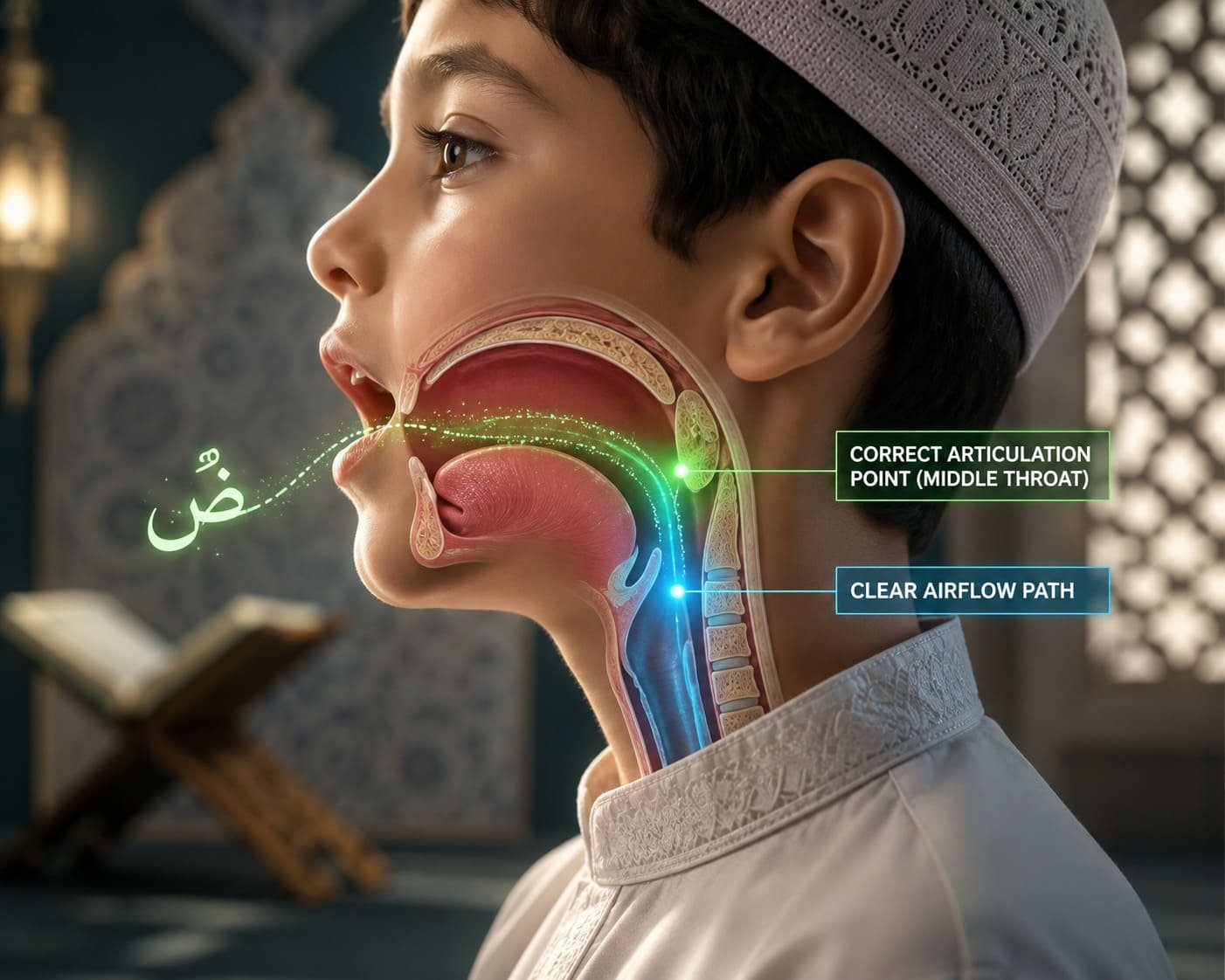
This is where enrolling in online Tajweed classes for beginners makes a massive difference. Certified tutors use real-time visual feedback, getting close to the camera to demonstrate mouth and tongue positions. They isolate specific sounds and use positive reinforcement, ensuring that correcting Tajweed mistakes in Surah Fatiha feels like a fun challenge rather than a chore.
Parent Guide: How to Test Your Child’s Recitation Tonight
You do not need to be fluent in Arabic to ensure your child is on the right track. Use this quick 3-step listening guide tonight:
- The “An’amta” Test: Listen to the middle of the Surah. Does “An’amta” sound flat, or do you hear a slight squeeze in their throat?
- The “Siraat” Smile Check: Watch their face during “Ihdina-s-Siraat”. If they are smiling, they are using the light English letters instead of the heavy Arabic ones.
- The 6-Second Finger Count: When they reach “Wa lad-daaaalleen”, count silently in your head. Did they stretch it for six full seconds?
Is your child reciting Surah Al-Fatiha accurately?
Bad habits can form easily, but they are just as easy to correct with the right guidance. Give your child the confidence to stand in prayer knowing they are pronouncing the words of Allah exactly as they were revealed.
Schedule a Free Recitation Assessment Session at Quran Bil Tajweed today, and let our certified tutors help build a custom, engaging plan to perfect their recitation.
Frequently Asked Questions (FAQs)
Why is it so important to fix Tajweed mistakes in Surah Fatiha specifically?
Surah Al-Fatiha is a mandatory part of every single unit of the daily prayers. A Muslim recites it at least 17 times a day. Because Arabic is a very precise language, mispronouncing certain letters can completely change the meaning of the verses, which affects the validity of the prayer.
What are the most common Tajweed mistakes in Surah Fatiha made by beginners?
The most widespread mistake is confusing the ‘Ayn (ع) with the Alif (أ) in the word “An’amta”. Because the English language does not have the middle-throat ‘Ayn sound, children naturally default to making both letters sound like a flat, standard ‘A’.
How can I tell if my child is mixing up heavy and light letters?
You can use the “smile test.” When your child says a light letter like Seen (س), their lips should pull back into a slight smile. When they pronounce a heavy letter like Saad (ص), their face should remain neutral and their mouth should feel full of air. If they are smiling while saying a heavy letter, they are mispronouncing it.
Do I need to be fluent in Arabic to help my child with their Tajweed?
Not at all. While being fluent helps, you can easily catch major mistakes by listening for specific cues, like whether they stretch the word “Wa lad-daaaalleen” for a full six seconds, or if they drop the throat sounds in “Alhamdulillah”. However, for consistent correction, working with certified online Tajweed tutors is highly recommended.
When is the best time to enroll my child in online Tajweed classes?
The best time is as soon as they begin memorizing short Surahs. Correcting pronunciation early is much easier than trying to break deeply ingrained bad habits when they become teenagers. A strong foundation from the start ensures they recite with confidence for the rest of their lives.